The Sri Lankan Government last month declared that its military operation against Tamil rebels has ended, but there remain a number of outstanding issues that if left unaddressed could lead more violence, stated Secretary-General Ban Ki-moon.
In his remarks at a gala at the Foreign Policy Association in New York, Mr. Ban said that he has made it clear to President Mahinda Rajapaksa that though the fighting might be over, “there is much more to do.”
Mr. Ban, who was honoured with an award in recognition of his efforts in tackling global humanitarian issues, expressed his deep concern over the situation in Sri Lanka’s refugee camps.
He got a first-hand look at the situation in the camps, which are housing over 280,000 people displaced by the recently-concluded conflict between the Government and Tamil rebels, when he visited the country from 22 to 23 May.
In recent days, he has said that the Government has addressed some concerns he raised over humanitarian access to the camps, and that he was encouraged by its commitment to return 80 per cent of those displaced in the fighting to their homes by the end of this year. Nevertheless, he has noted that the conditions in the camps remain difficult.
“People must be allowed to return to their homes. There must be reconciliation. The Government of Sri Lanka must hold out their hands to the minority,” he told last night’s gathering.
“If this is not addressed, there might be more violence,” he warned.
The Secretary-General also called for accountability for those who may have committed human rights abuses, as was agreed in the joint statement issued with the Government at the end of his recent visit.
Mr. Ban reiterated his commitment to continue his work for the people of Sri Lanka, and for all people suffering from breaches of humanitarian law and human rights, in a wide-ranging speech that also touched on the violence plaguing various parts of the world, the economic crisis, and climate change.
http://www.youtube.com/watch?v=yBDxtTpIDIo
Saturday, June 20, 2009

‘Enter the Dragon’ after end of the ‘Tigers’

dailymirror
The Sri Lanka’s (SL) Ambassador in Geneva , Dayan Jayatileke recently , extolled China at the United Nations Human Rights Commission (UNHRC) . He praised thus because China took steps to support the resolution in favour of Sri Lanka thereby defeating that brought against SL at the UNHRC. It is evident from this that China is not only assisting SL in the war , but is protecting it in the diplomatic front too.
Immediately prior to these enunciations of Jayatileke , at an interview with the Indian media, President Mahinda Rajapaksa declared that he fought India’s war. In other words , the annihilation of the Tamil Tigers who killed India’s leader and was a threat to India is a victory for India. In that case , it brings to question why China helped SL to win the war ?- A victory which was India’s necessity .The Indian media had reported that China provided arms, funds and even advice to SL to destroy the Tamil Tigers . According to some Indian media reports , China supplied six F 7 jets free of charge in 2008. It is indeed therefore baffling as to why China which considers India as its rival in the region went this far to help SL win the war, which victory India also was desirous.
It was only after China signed the agreement with SL for the construction of the Hambantota harbour that China went out of the way to help the SL Govt. in the war. If China is to establish its hegemony in the Indian Ocean , the Hambantota harbour will be a vital centre . Pakistan , Bangladesh and Myanmar harbours will be the other Centres to serve China’s objective. This constitutes the ‘ring of pearls’. What is most worth for China is the Hambantota harbour, because SL is described as the ‘crown’ of the Indian Ocean. But, if this ‘crown’ is to be owned by way of the Hambantota harbour, SL must become a protected Country absolutely free from terrorist threats whatsoever . Not only the SL Govt., even China became restless and distraught at the time when Hambantota came under Tamil Tiger threats .This was because China was opposed to Hambantota coming under terrorist threats . To China, not only Hambantota , the whole of SL’s security and its fortification are important for its regional hegemony . It is on this account China helped SL wholeheartedly to defeat the Tamil Tigers.
The majority of the inhabitants of Hambantota are Sinhala Buddhists. It is also the ruling Rajapaksa and his family’s political territory. Besides, it is JVP’s stronghold. The JVP , a left wing party is not well disposed towards India . Although China does not interfere with SL’s internal affairs , it has a close rapport with the JVP. The latter’s vigilance against India’s undue pressures gives solace to China though it may not perhaps be instigating the JVP. Above all ,China is assured of political security by the President Rajapaksa family from Hambantota.
Going by the profound links between the Rajapaksa Govt. and China , and latter’s relationship with the JVP , it is clear ,today these ties are stronger than the strength India wielded over the Tamil politics in SL during the period 1983 to 1987 . India during that period was manipulating SL politics via the Tamil politicians and the Tamil armed groups . However , China has not still reached this stage of manipulative politics in SL . Yet, in the backdrop of the close ties and rapport China has built within the SL politics and the media today , reaching that stage is not a distant or difficult task.
Following the liquidation of the Tamil Tigers , India is posed with a problem of renewed thinking to look out for avenues to manipulate SL politics. May be, India is getting down SL’s TNA politicians to console them with this objective in view.
Today, China is well ahead of India in its involvements in SL . It is apparent that the opinions of the Sri Lankans are not in disfavour of China’s stance towards SL. A majority of Sri Lankans are well disposed towards China for its contributions to the annihilation of the Tamil Tigers and China’s stance towards the development process of SL. But, a majority of the Sri Lankans are antagonistic to India’s insistence on a political solution for the Tamil community. Earlier, the majority were in favour of it despite their dislike . That was during the Tamil Tigers’ reign of terror, when they agreed to a political solution fearing the terrorism of the Tamil Tigers.
If India was to win over the Tamil politicians and the Tamil community for their political manipulations in SL, it should have found a political solution for the Tamils during the terror reign of the Tamil Tigers . But now it is too late. From every angle , India is now in a deep quandary unable to outwit China’s manoeuvres within SL.
At present, China has no cause to manipulate SL ‘s politics though it may be watchful in respect of the future elections in SL and the Govt. which may be elected to power . In the event of a new Govt. being installed in power following the change of the Rajapaksa Govt., the new Govt.’s posture towards the Hambantota harbour will be of prime importance to China . Prior to the Hambantota harbour construction , China had no concern about which Govt. was elected to power in SL. But now it is not so; because of the harbour , China in the future will be obliged to resort to manipulative politics in SL owing to the Hambantota harbour In any case , some sources say , China is more inclined to exert pressure on the SL Govt. and its Army rather than on SL politics . There seems to be a truth in this as China has been maintaining cordial and profound relations with SL’s Defense establishment during the war to crush the Tamil Tigers. As the SL’s Defense Establishment’s strength is growing progressively , so does the security relating to the Hambantota harbour conforming to China’s requirements . The new stringent measures taken by the SL’s defense Establishment to protect the Island’s coastal belt seems to be to the liking of China , for SL’s security is crucial for China’s ‘ring of pearls’
UN says two staff members arrested in Sri Lanka
Sat Jun 20, 4:46 AM
COLOMBO (AFP) - The United Nations said on Sunday that two of its employees working among tens of thousands of war-displaced civilians had been arrested by Sri Lankan authorities.
The two men, both ethnic Sri Lankan Tamils, were reported missing eight days ago and were subsequently discovered to have been taken into custody by Sri Lankan officials, the UN office in Colombo said in a statement.
"We are not aware which, if any, charges have been laid, and nor are we aware of the details of any accusations," the statement said.
The two men were working for the UN refugee agency and the UN office for Project Services in the northern region of Vavuniya
Human rights organisations have reported that thousands of Tamils had been taken from the state-run camps for people displaced by the recently ended war between troops and Tamil Tiger rebels.
The UN has often been at odds with the Sri Lankan government over Colombo's handling of the final days of battle against the rebels and the treatment of 300,000 people displaced by the fighting.
The separatist Tamil Tigers were defeated last month when they lost the remaining territory under their control and their founder and chief Velupillai Prabhakaran was killed.
COLOMBO (AFP) - The United Nations said on Sunday that two of its employees working among tens of thousands of war-displaced civilians had been arrested by Sri Lankan authorities.
The two men, both ethnic Sri Lankan Tamils, were reported missing eight days ago and were subsequently discovered to have been taken into custody by Sri Lankan officials, the UN office in Colombo said in a statement.
"We are not aware which, if any, charges have been laid, and nor are we aware of the details of any accusations," the statement said.
The two men were working for the UN refugee agency and the UN office for Project Services in the northern region of Vavuniya
Human rights organisations have reported that thousands of Tamils had been taken from the state-run camps for people displaced by the recently ended war between troops and Tamil Tiger rebels.
The UN has often been at odds with the Sri Lankan government over Colombo's handling of the final days of battle against the rebels and the treatment of 300,000 people displaced by the fighting.
The separatist Tamil Tigers were defeated last month when they lost the remaining territory under their control and their founder and chief Velupillai Prabhakaran was killed.
In Sri Lanka Camps, UN Blind and Deaf Without Cameras or Cell Phones, African Concern
[ InnerCity Press ][ Jun 20 03:18 GMT ]
While it has been reported that in the UN-funded internment camps in Sri Lanka "UN officials have been stopped from bringing in cameras and mobile phones," the Spokesperson for Secretary General Ban Ki-moon on Friday told Inner City Press, "I don't think the UN would accept that." Since the UN did accept the detention by the government of UN staff earlier this year, it is not clear if the UN would accept being barred from exposing abuses they see in the camps or even photographing them. [ full story]
While it has been reported that in the UN-funded internment camps in Sri Lanka "UN officials have been stopped from bringing in cameras and mobile phones," the Spokesperson for Secretary General Ban Ki-moon on Friday told Inner City Press, "I don't think the UN would accept that." Since the UN did accept the detention by the government of UN staff earlier this year, it is not clear if the UN would accept being barred from exposing abuses they see in the camps or even photographing them. [ full story]
Sri Lanka standby loan still not ready for board approval: IMF official
Sri Lanka standby loan still not ready for board approval: IMF official[ LBO ] - [ Jun 20, 2009 03:12 GMT ]
June 20, 2009- An International Monetary Fund loan for Sri Lanka is still not ready for approval for its executive board, an official said, though the country is rapidly emerging from a balance of payments crisis.
IMF spokesperson Caroline Atkinson said Friday "whenever there is final agreement, then a program would go to the Executive Board."
Last month Atkinson said she expected the loan of at least 1.9 billion US dollars to be approved within "weeks".
The loan had been delayed as it awaited approval from the US Treasury, which also consults other agencies, including the State Department, which is yet to approve the loan.
The US executive director votes on the loan after receiving a report from the international monetary affairs office of the Treasury. The US has to biggest share of votes in the IMF.
In March Sri Lanka floated the rupee as a prior action to the loan and the country's balance of payments has since turned.
Balance of payments crises are caused when a central bank sells foreign exchange to keep an exchange rate peg and prints domestic money at the same time, undermining the same objective.
The vicious cycle can rapidly deplete foreign reserves backing the local currency issue. Net foreign assets of Sri Lanka's central bank fell from about 3.0 billion dollars to 830 million US dollars during the peg defence period.
June 20, 2009- An International Monetary Fund loan for Sri Lanka is still not ready for approval for its executive board, an official said, though the country is rapidly emerging from a balance of payments crisis.
IMF spokesperson Caroline Atkinson said Friday "whenever there is final agreement, then a program would go to the Executive Board."
Last month Atkinson said she expected the loan of at least 1.9 billion US dollars to be approved within "weeks".
The loan had been delayed as it awaited approval from the US Treasury, which also consults other agencies, including the State Department, which is yet to approve the loan.
The US executive director votes on the loan after receiving a report from the international monetary affairs office of the Treasury. The US has to biggest share of votes in the IMF.
In March Sri Lanka floated the rupee as a prior action to the loan and the country's balance of payments has since turned.
Balance of payments crises are caused when a central bank sells foreign exchange to keep an exchange rate peg and prints domestic money at the same time, undermining the same objective.
The vicious cycle can rapidly deplete foreign reserves backing the local currency issue. Net foreign assets of Sri Lanka's central bank fell from about 3.0 billion dollars to 830 million US dollars during the peg defence period.
Friday, June 19, 2009
POLITICAL SOLUTION – MISSING IN ACTION
by-m.s.m.ayub
[ Daily Mirror ]
The focus of Tamil media has shifted from people entrapped in the one time LTTE held areas in Mullaitivu to the people in camps which are called welfare camps by the Government and detention camps by the anti-government elements. Tamil media or for that matter the Tamil politicians do not seem to place much emphasis after the physical decimation of the LTTE on the political solution to the ethnic problem that was once much talked about.
However, this surely does not mean that the politically conscious Tamils consider that the political solution they were fighting for is no more needed with the defeat of the Tigers. They seem to be nervous to speak about matters that would upset the euphoric psyche of the southern people. Occasionally some Tamil politicians are being heard meekly grumbling over the lack of enthusiasm on the part of the Government to find a political solution to the ethnic problem. Otherwise Tamil media and politicians are obsessed now with the situation in the camps where the people displaced from all over the Wanni are housed.
It is clear that the Government cannot and would not hold them in camps forever or at least for years. Once the infrastructure including electricity and water supply is restored, roads, paddy fields, vegetable plots, surroundings of schools and houses, lakes and irrigation canals are cleared of landmines and booby traps and also once the houses damaged and destroyed by the war are repaired or rebuilt, people have to be resettled. Authorities might take steps to screen these internally displaced people (IDP) for possible LTTE cadres and sympathizers in the meantime.
Irrespective of the fact where these people live, in camps or in their original places, people would tend to talk politics and concentrate on the lethargy in the state machinery and again will begin to paint things in ethnic colours, once they begin to bury the harrowing memories of cruelty and the barbarity of the war. Even if the ordinary people do not want to see things in ethnic colours politicians in the South as well as in the North would show the things to them in such colours. Then again Tamil politicians will cry for political solutions and go on pilgrimages to Chennai, Delhi and Western capitals.
Under the present circumstances where the euphoria over the war victory coupled with majoritarian triumphalism reigns, the people in the North as well as the South, no one would dare to press the Government hard for a political solution since it would earn the wrath of the majority. But the question is what is the government going to do in this regard? One may argue that there is no need for a political solution or for that matter a pacification process now that the LTTE has been crushed, their leaders have been killed, every inch under their writ has been recaptured by the troops and the vast arsenal the outfit possessed has been confiscated by the state.
Also one may argue that even if the LTTE or any other Tamil group resumes another rebellion, it can be crushed as the LTTE, the most ruthless and powerful terrorist outfit in the world according to some analysts was decimated and that therefore, there is no point in wasting time and energy in finding political solutions to the Tamil grievances.
There have been controversies over many Tamil demands, but some of their demands such as the right to work in their own language are uncontestable. Those are the rights that cannot be given by any other community. They are birth rights of communities. Talking about giving rights to another community is itself a term soaked with racism. Any community can plunder rights of other communities if they have power, but no community can offer rights as the rights are natural. Only thing other communities can do is to recognize them and act accordingly. Likewise what the Tamils (not some of the Tamil parties) expect the rulers and the other communities is not to give them their rights, but to recognize them.
No one for the moment denies that the Government troops would crush any powerful or ruthless insurgency as they did in respect of the LTTE. But the important question one may pose in response to that is whether we should create a situation which can in turn present a bloody insurrection for us to test our military prowess destroying thousands of lives and property worth billions in the decades to come. Some form of reconciliatory process therefore must be in place to avert a re-emergence of ethnic animosities and recurrence of bloodshed. You may call this a political solution while another may treat it as a corrective measure. Even the stance of the JVP that is dead against the political solutions and devolution of power is that bringing about equality among communities would solve the current problem. It is an admission that there are inequalities among communities and the need for corrective measures.
However, the “universally” accepted term for the remedy for the Sri Lankan ethnic issue seems to be political solution or more specifically the devolution of power. The UN Secretary General Ban-Ki-Moon, the Japanese special envoy Yasushi Akashi and various foreign leaders have been referring to a political solution to the ethnic problem during their recent visits to Sri Lanka. Indian leaders too are invariably calling for political solutions.
Government’s stance in this regard is extremely vague. President Mahinda Rajapaksa while addressing the nation to announce the defeat of the LTTE said in parliament on May 19 that, “it is necessary that the political solutions they need should be brought closer to them faster than any country or government in the world would bring.” This manifests that he has understood the need of corrective measures to the mishandling of issues by the past governments.
Also the joint communiqué issued by the Sri Lankan Government and the United Nations at the end of the UN Secretary General Ban-Ki-Moon’s visit to Sri Lanka last month said that “President Rajapaksa and the Secretary-General agreed that addressing the aspirations and grievances of all communities and working towards a lasting political solution was fundamental to ensuring long-term socio-economic development.”
However, Government does not seem to have a concrete programme to evolve any political solution other than the over dragged APRC process. On the other hand parliamentarian Wimal Weerawansa a close ally of the Government ridiculed APRC Chairman Professor Tissa Vitharana openly claiming that President Rajapaksa had found fault with Vitharana for mentioning about the political solution at a meeting held to pay tribute to the security forces. This casts doubts on the credibility of the government.
Even if we agree on the need for a political solution, it is high time for the experts to survey whether devolution of power is the only structural setup that can ensure the rights of the various communities, since Sri Lanka has already experimented the system for the past twenty years.
However, taking into account the mood of the southern people, the degree of pressure on the Government for political solution and the confusion in the country over what the lasting solution should be, it is surmisable that the status quo in respect of political solution would be the same for some years to come.
[ Daily Mirror ]
The focus of Tamil media has shifted from people entrapped in the one time LTTE held areas in Mullaitivu to the people in camps which are called welfare camps by the Government and detention camps by the anti-government elements. Tamil media or for that matter the Tamil politicians do not seem to place much emphasis after the physical decimation of the LTTE on the political solution to the ethnic problem that was once much talked about.
However, this surely does not mean that the politically conscious Tamils consider that the political solution they were fighting for is no more needed with the defeat of the Tigers. They seem to be nervous to speak about matters that would upset the euphoric psyche of the southern people. Occasionally some Tamil politicians are being heard meekly grumbling over the lack of enthusiasm on the part of the Government to find a political solution to the ethnic problem. Otherwise Tamil media and politicians are obsessed now with the situation in the camps where the people displaced from all over the Wanni are housed.
It is clear that the Government cannot and would not hold them in camps forever or at least for years. Once the infrastructure including electricity and water supply is restored, roads, paddy fields, vegetable plots, surroundings of schools and houses, lakes and irrigation canals are cleared of landmines and booby traps and also once the houses damaged and destroyed by the war are repaired or rebuilt, people have to be resettled. Authorities might take steps to screen these internally displaced people (IDP) for possible LTTE cadres and sympathizers in the meantime.
Irrespective of the fact where these people live, in camps or in their original places, people would tend to talk politics and concentrate on the lethargy in the state machinery and again will begin to paint things in ethnic colours, once they begin to bury the harrowing memories of cruelty and the barbarity of the war. Even if the ordinary people do not want to see things in ethnic colours politicians in the South as well as in the North would show the things to them in such colours. Then again Tamil politicians will cry for political solutions and go on pilgrimages to Chennai, Delhi and Western capitals.
Under the present circumstances where the euphoria over the war victory coupled with majoritarian triumphalism reigns, the people in the North as well as the South, no one would dare to press the Government hard for a political solution since it would earn the wrath of the majority. But the question is what is the government going to do in this regard? One may argue that there is no need for a political solution or for that matter a pacification process now that the LTTE has been crushed, their leaders have been killed, every inch under their writ has been recaptured by the troops and the vast arsenal the outfit possessed has been confiscated by the state.
Also one may argue that even if the LTTE or any other Tamil group resumes another rebellion, it can be crushed as the LTTE, the most ruthless and powerful terrorist outfit in the world according to some analysts was decimated and that therefore, there is no point in wasting time and energy in finding political solutions to the Tamil grievances.
There have been controversies over many Tamil demands, but some of their demands such as the right to work in their own language are uncontestable. Those are the rights that cannot be given by any other community. They are birth rights of communities. Talking about giving rights to another community is itself a term soaked with racism. Any community can plunder rights of other communities if they have power, but no community can offer rights as the rights are natural. Only thing other communities can do is to recognize them and act accordingly. Likewise what the Tamils (not some of the Tamil parties) expect the rulers and the other communities is not to give them their rights, but to recognize them.
No one for the moment denies that the Government troops would crush any powerful or ruthless insurgency as they did in respect of the LTTE. But the important question one may pose in response to that is whether we should create a situation which can in turn present a bloody insurrection for us to test our military prowess destroying thousands of lives and property worth billions in the decades to come. Some form of reconciliatory process therefore must be in place to avert a re-emergence of ethnic animosities and recurrence of bloodshed. You may call this a political solution while another may treat it as a corrective measure. Even the stance of the JVP that is dead against the political solutions and devolution of power is that bringing about equality among communities would solve the current problem. It is an admission that there are inequalities among communities and the need for corrective measures.
However, the “universally” accepted term for the remedy for the Sri Lankan ethnic issue seems to be political solution or more specifically the devolution of power. The UN Secretary General Ban-Ki-Moon, the Japanese special envoy Yasushi Akashi and various foreign leaders have been referring to a political solution to the ethnic problem during their recent visits to Sri Lanka. Indian leaders too are invariably calling for political solutions.
Government’s stance in this regard is extremely vague. President Mahinda Rajapaksa while addressing the nation to announce the defeat of the LTTE said in parliament on May 19 that, “it is necessary that the political solutions they need should be brought closer to them faster than any country or government in the world would bring.” This manifests that he has understood the need of corrective measures to the mishandling of issues by the past governments.
Also the joint communiqué issued by the Sri Lankan Government and the United Nations at the end of the UN Secretary General Ban-Ki-Moon’s visit to Sri Lanka last month said that “President Rajapaksa and the Secretary-General agreed that addressing the aspirations and grievances of all communities and working towards a lasting political solution was fundamental to ensuring long-term socio-economic development.”
However, Government does not seem to have a concrete programme to evolve any political solution other than the over dragged APRC process. On the other hand parliamentarian Wimal Weerawansa a close ally of the Government ridiculed APRC Chairman Professor Tissa Vitharana openly claiming that President Rajapaksa had found fault with Vitharana for mentioning about the political solution at a meeting held to pay tribute to the security forces. This casts doubts on the credibility of the government.
Even if we agree on the need for a political solution, it is high time for the experts to survey whether devolution of power is the only structural setup that can ensure the rights of the various communities, since Sri Lanka has already experimented the system for the past twenty years.
However, taking into account the mood of the southern people, the degree of pressure on the Government for political solution and the confusion in the country over what the lasting solution should be, it is surmisable that the status quo in respect of political solution would be the same for some years to come.
Aid gets into Sri Lanka camps, few people get out: U.N.
[ Reuters ]
By Laura MacInnis
GENEVA (Reuters) - Humanitarian aid is getting into Sri Lanka's war displacement camps, but very few of the 280,000 people they house are being allowed out, the top United Nations aid official said on Friday.
U.N. emergency relief coordinator John Holmes said survivors of the brutal civil war that Colombo declared over in May needed to be permitted to resume normal lives in order to ease tensions in the country's northeast.
Aid vehicles carrying food, health and other supplies are now gaining access to the camps which were closed to trucks in the first days after the 25-year fighting stopped, Holmes told a news conference in Geneva.
"We do have pretty much full access to those camps at the moment," he said, noting that problems with overcrowding and inadequate water and sanitation facilities with the onset of disease-spreading monsoon rains were gradually being overcome.
"What is more worrying is the nature of the camps themselves. They could be described as internment camps in some respects, in the sense that people are not allowed to move freely in and out of them for the moment," Holmes continued.
Sri Lanka has said it is in control of the refugee situation and blasted Western governments for their attempts at the United Nations to shine a light on reported transgressions during and after its war against the separatist Tamil Tigers.
Sri Lanka's government has said it aims to have 80 percent of the population back to their villages of origin by the end of the year, and will work to give ethnic Tamils a strong political voice in the majority Sinhalese nation.
Holmes said United Nations officials are "discussing in a very intensive way with the government" ways to buoy the welfare of people in the camps and to help them get home quickly.
Such issues he said "are crucial, not only for the sake of the people in the camps, but also for the sake of the future political reconciliation which absolutely needs to happen."
(Editing by Philippa Fletcher)
By Laura MacInnis
GENEVA (Reuters) - Humanitarian aid is getting into Sri Lanka's war displacement camps, but very few of the 280,000 people they house are being allowed out, the top United Nations aid official said on Friday.
U.N. emergency relief coordinator John Holmes said survivors of the brutal civil war that Colombo declared over in May needed to be permitted to resume normal lives in order to ease tensions in the country's northeast.
Aid vehicles carrying food, health and other supplies are now gaining access to the camps which were closed to trucks in the first days after the 25-year fighting stopped, Holmes told a news conference in Geneva.
"We do have pretty much full access to those camps at the moment," he said, noting that problems with overcrowding and inadequate water and sanitation facilities with the onset of disease-spreading monsoon rains were gradually being overcome.
"What is more worrying is the nature of the camps themselves. They could be described as internment camps in some respects, in the sense that people are not allowed to move freely in and out of them for the moment," Holmes continued.
Sri Lanka has said it is in control of the refugee situation and blasted Western governments for their attempts at the United Nations to shine a light on reported transgressions during and after its war against the separatist Tamil Tigers.
Sri Lanka's government has said it aims to have 80 percent of the population back to their villages of origin by the end of the year, and will work to give ethnic Tamils a strong political voice in the majority Sinhalese nation.
Holmes said United Nations officials are "discussing in a very intensive way with the government" ways to buoy the welfare of people in the camps and to help them get home quickly.
Such issues he said "are crucial, not only for the sake of the people in the camps, but also for the sake of the future political reconciliation which absolutely needs to happen."
(Editing by Philippa Fletcher)
China Crosses the Rubicon
[ Kosovo Times ][ Jun 19 17:30 GMT ]
This article is published honoring the exchange between members of the Project Syndicate network. "The Kosovo Times" is a member of the "Project Syndicate" network.By Wen LiaoLONDON – For two decades, Chinese diplomacy has been guided by the concept of the country’s “peaceful rise.” Today, however, China needs a new strategic doctrine, because the most remarkable aspect of Sri Lanka’s recent victory over the Tamil Tigers is not its overwhelming nature, but the fact that China provided President Mahinda Rajapaska with both the military supplies and diplomatic cover he needed to prosecute the war.Without that Chinese backing, Rajapaska’s government would have had neither the wherewithal nor the will to ignore world opinion in its offensive against the Tigers. So, not only has China become central to every aspect of the global financial and economic system, it has now demonstrated its strategic effectiveness in a region traditionally outside its orbit. On Sri Lanka’s beachfront battlefields, China’s “peaceful rise” was completed.What will this change mean in practice in the world’s hot spots like North Korea, Pakistan, and Central Asia?Before the global financial crisis hit, China benefited mightily from the long boom along its eastern and southern rim, with only Burma and North Korea causing instability. China’s west and south, however, have become sources of increasing worry.Given economic insecurity within China in the wake of the financial crisis and global recession, China’s government finds insecurity in neighbouring territories more threatening than ever. Stabilizing its neighbourhood is one reason why China embraces the six-party talks with North Korea, has become a big investor in Pakistan (while exploring ways to cooperate with President Barack Obama’s special representative, Richard Holbrooke), signed on to a joint Asia/Europe summit declaration calling for the release from detention of Burmese opposition leader Daw Aung Suu Kyi, and intervened to help end Sri Lanka’s 26-year civil war.The calculus behind China’s emerging national security strategy is simple. Without peace and prosperity around China's long borders, there can be no peace, prosperity, and unity at home. China’s intervention in Sri Lanka, and its visibly mounting displeasure with the North Korean and Burmese regimes, suggests that this calculus has quietly become central to the government’s thinking.For example, though China said little in public about Russia’s invasion and dismemberment of Georgia last summer, Russia is making a strategic mistake if it equates China’s public silence with tacit acquiescence in the Kremlin’s claim to “privileged” influence in the post-Soviet countries to China’s west.Proof of China’s displeasure was first seen at the 2008 summit of the Shanghai Cooperation Organization (a regional grouping that includes former Soviet countries that share borders with China and Russia). Russian President Dmitri Medvedev pushed the SCO to recognize the independence of Abkhazia and South Ossetia. But the SCO balked. The group’s Central Asian members – Kazakhstan, Kyrgyzstan, Tajikistan, and Uzbekistan – would not have stood up to the Kremlin without China’s support.At this year’s just-concluded SCO summit, the pattern continued. The brief appearance of Iran’s disputed President Mahmoud Ahmadinejad may have gained all the headlines, but China’s announcement of a $10 billion fund to support the budgets of financially distressed ex-Soviet states, which followed hard on a $3 billion investment in Turkmenistan and a $10 billion investment in Kazakhstan, provides more evidence that China now wants to shape events across Eurasia.Vladimir Putin famously described the break-up of the Soviet Union as the greatest geo-political catastrophe of the twentieth century. From China’s standpoint, however, the Soviet collapse was the greatest strategic gain imaginable. At a stroke, the empire that had gobbled up Chinese territories for centuries vanished. The Soviet military threat – once so severe that Chairman Mao invited President Richard Nixon to China to change the Cold War balance of power – was eliminated. China’s new assertiveness suggests that it will not allow Russia to forge a de facto Soviet Reunion and thus undo the post-Cold War settlement, under which China’s economy flourished and security increased.So far, China’s rulers have regarded emerging strategic competition with India, Japan, Russia, and the United States as a jostling for influence in Central and South Asia. China’s strategic imperatives in this competition are twofold: to ensure that no rival acquires a dangerous “privileged influence” in any of its border regions; and to promote stability so that trade, and the sea lanes through which it passes (hence China’s interest in Sri Lanka and in combating Somali pirates), is protected.In the 1990s, China sought to mask its “peaceful rise” behind a policy of “smile diplomacy” designed to make certain that its neighbours did not fear it. China lowered trade barriers and offered soft loans and investments to help its southern neighbours. Today, China’s government seeks to shape the diplomatic agenda in order to increase China’s options while constricting those of potential adversaries. Instead of remaining diplomatically aloof, China is forging more relationships with its neighbours than any of its rivals. This informal web is being engineered not only to keep its rivals from coalescing or gaining privileged influence, but also to restrain the actions of China’s local partners so as to dampen tension anywhere it might flare up.China’s newfound assertiveness, rather than creating fear, should be seen as establishing the necessary conditions for comprehensive negotiations about the very basis of peaceful coexistence and stability in Asia: respect for all sides’ vital interests. In recent years, such an approach ran counter to America’s foreign-policy predisposition of favouring universalist doctrines over a careful balancing of national interests. With the Obama administration embracing realism as its diplomatic lodestar, China may have found a willing interlocutor. Wen Liao is Chairwoman of Longford Advisors, a political, economic, and business consultancy.
This article is published honoring the exchange between members of the Project Syndicate network. "The Kosovo Times" is a member of the "Project Syndicate" network.By Wen LiaoLONDON – For two decades, Chinese diplomacy has been guided by the concept of the country’s “peaceful rise.” Today, however, China needs a new strategic doctrine, because the most remarkable aspect of Sri Lanka’s recent victory over the Tamil Tigers is not its overwhelming nature, but the fact that China provided President Mahinda Rajapaska with both the military supplies and diplomatic cover he needed to prosecute the war.Without that Chinese backing, Rajapaska’s government would have had neither the wherewithal nor the will to ignore world opinion in its offensive against the Tigers. So, not only has China become central to every aspect of the global financial and economic system, it has now demonstrated its strategic effectiveness in a region traditionally outside its orbit. On Sri Lanka’s beachfront battlefields, China’s “peaceful rise” was completed.What will this change mean in practice in the world’s hot spots like North Korea, Pakistan, and Central Asia?Before the global financial crisis hit, China benefited mightily from the long boom along its eastern and southern rim, with only Burma and North Korea causing instability. China’s west and south, however, have become sources of increasing worry.Given economic insecurity within China in the wake of the financial crisis and global recession, China’s government finds insecurity in neighbouring territories more threatening than ever. Stabilizing its neighbourhood is one reason why China embraces the six-party talks with North Korea, has become a big investor in Pakistan (while exploring ways to cooperate with President Barack Obama’s special representative, Richard Holbrooke), signed on to a joint Asia/Europe summit declaration calling for the release from detention of Burmese opposition leader Daw Aung Suu Kyi, and intervened to help end Sri Lanka’s 26-year civil war.The calculus behind China’s emerging national security strategy is simple. Without peace and prosperity around China's long borders, there can be no peace, prosperity, and unity at home. China’s intervention in Sri Lanka, and its visibly mounting displeasure with the North Korean and Burmese regimes, suggests that this calculus has quietly become central to the government’s thinking.For example, though China said little in public about Russia’s invasion and dismemberment of Georgia last summer, Russia is making a strategic mistake if it equates China’s public silence with tacit acquiescence in the Kremlin’s claim to “privileged” influence in the post-Soviet countries to China’s west.Proof of China’s displeasure was first seen at the 2008 summit of the Shanghai Cooperation Organization (a regional grouping that includes former Soviet countries that share borders with China and Russia). Russian President Dmitri Medvedev pushed the SCO to recognize the independence of Abkhazia and South Ossetia. But the SCO balked. The group’s Central Asian members – Kazakhstan, Kyrgyzstan, Tajikistan, and Uzbekistan – would not have stood up to the Kremlin without China’s support.At this year’s just-concluded SCO summit, the pattern continued. The brief appearance of Iran’s disputed President Mahmoud Ahmadinejad may have gained all the headlines, but China’s announcement of a $10 billion fund to support the budgets of financially distressed ex-Soviet states, which followed hard on a $3 billion investment in Turkmenistan and a $10 billion investment in Kazakhstan, provides more evidence that China now wants to shape events across Eurasia.Vladimir Putin famously described the break-up of the Soviet Union as the greatest geo-political catastrophe of the twentieth century. From China’s standpoint, however, the Soviet collapse was the greatest strategic gain imaginable. At a stroke, the empire that had gobbled up Chinese territories for centuries vanished. The Soviet military threat – once so severe that Chairman Mao invited President Richard Nixon to China to change the Cold War balance of power – was eliminated. China’s new assertiveness suggests that it will not allow Russia to forge a de facto Soviet Reunion and thus undo the post-Cold War settlement, under which China’s economy flourished and security increased.So far, China’s rulers have regarded emerging strategic competition with India, Japan, Russia, and the United States as a jostling for influence in Central and South Asia. China’s strategic imperatives in this competition are twofold: to ensure that no rival acquires a dangerous “privileged influence” in any of its border regions; and to promote stability so that trade, and the sea lanes through which it passes (hence China’s interest in Sri Lanka and in combating Somali pirates), is protected.In the 1990s, China sought to mask its “peaceful rise” behind a policy of “smile diplomacy” designed to make certain that its neighbours did not fear it. China lowered trade barriers and offered soft loans and investments to help its southern neighbours. Today, China’s government seeks to shape the diplomatic agenda in order to increase China’s options while constricting those of potential adversaries. Instead of remaining diplomatically aloof, China is forging more relationships with its neighbours than any of its rivals. This informal web is being engineered not only to keep its rivals from coalescing or gaining privileged influence, but also to restrain the actions of China’s local partners so as to dampen tension anywhere it might flare up.China’s newfound assertiveness, rather than creating fear, should be seen as establishing the necessary conditions for comprehensive negotiations about the very basis of peaceful coexistence and stability in Asia: respect for all sides’ vital interests. In recent years, such an approach ran counter to America’s foreign-policy predisposition of favouring universalist doctrines over a careful balancing of national interests. With the Obama administration embracing realism as its diplomatic lodestar, China may have found a willing interlocutor. Wen Liao is Chairwoman of Longford Advisors, a political, economic, and business consultancy.
Holding leaders accountable helps prevent and resolve conflicts
By Joseph Derr
Rotary International News -- 19 June 2009
Accountability and telling it like it is are critical components of building peace, said Jan Egeland, director of the Norwegian Institute of International Affairs. Egeland was the UN secretary-general's special adviser for conflict prevention and resolution from 2006 to 2008.
At the second Rotary World Peace Symposium in Birmingham, England, on 19 June, Egeland discussed what he has learned during his career of more than 30 years in humanitarian relief and conflict resolution, which included participating in secret negotiations between Israelis and Palestinians to produce the Oslo Accord of 1993.
As a peace negotiator, said Egeland, it's important to hold leaders accountable for their action or inaction. "We have to speak the truth. I have tried to say it as I saw it."
He also observed that "we're making progress, thanks to the good work of Rotary and hundreds of other good, nongovernmental movements." For example, when the December 2004 tsunami hit Thailand and other countries in Southeast Asia, the response was highly coordinated and effective, he said. "We have succeeded more often than we've failed, and we've shown that we can do remarkable things when we work together."
Egeland said he feels optimistic knowing that a new generation of peacemakers coming out of Rotary's peace programs will have unparalleled knowledge, technology, and training to do the much-needed work.
"What he said about accountability is crucial," said Rebecca Gasca, a Rotaractor and 2003-04 Rotary Foundation Ambassadorial Scholar. "Not only is it at the leadership level that we have to hold each other accountable, but also at the grassroots level. I think there is a place for Rotary in both regards."
Ahamed Imthiaz Ismail, a member of the Rotary Club of Colombo Mid Town, Western Province, Sri Lanka, has mentored three Foundation Scholars and is involved in humanitarian land mine action and the resettlement of internally displaced people in his country. "His presentation was based on real-life experiences, and it had diverse views that you could relate to different circumstances and situations," said Ismail.
"I thought it was really inspiring to hear positive things and put a number of current conflicts in perspective," said Zélie Pollon, a Rotary World Peace Fellow from Santa Fe, New Mexico, USA, who graduated from Rotary's professional development program at Chulalongkorn University in Thailand and will enter the University of Bradford in a few months. "In tandem, it's also good to be reminded of the things we're not focusing on that we can do."
Rotary International News -- 19 June 2009
Accountability and telling it like it is are critical components of building peace, said Jan Egeland, director of the Norwegian Institute of International Affairs. Egeland was the UN secretary-general's special adviser for conflict prevention and resolution from 2006 to 2008.
At the second Rotary World Peace Symposium in Birmingham, England, on 19 June, Egeland discussed what he has learned during his career of more than 30 years in humanitarian relief and conflict resolution, which included participating in secret negotiations between Israelis and Palestinians to produce the Oslo Accord of 1993.
As a peace negotiator, said Egeland, it's important to hold leaders accountable for their action or inaction. "We have to speak the truth. I have tried to say it as I saw it."
He also observed that "we're making progress, thanks to the good work of Rotary and hundreds of other good, nongovernmental movements." For example, when the December 2004 tsunami hit Thailand and other countries in Southeast Asia, the response was highly coordinated and effective, he said. "We have succeeded more often than we've failed, and we've shown that we can do remarkable things when we work together."
Egeland said he feels optimistic knowing that a new generation of peacemakers coming out of Rotary's peace programs will have unparalleled knowledge, technology, and training to do the much-needed work.
"What he said about accountability is crucial," said Rebecca Gasca, a Rotaractor and 2003-04 Rotary Foundation Ambassadorial Scholar. "Not only is it at the leadership level that we have to hold each other accountable, but also at the grassroots level. I think there is a place for Rotary in both regards."
Ahamed Imthiaz Ismail, a member of the Rotary Club of Colombo Mid Town, Western Province, Sri Lanka, has mentored three Foundation Scholars and is involved in humanitarian land mine action and the resettlement of internally displaced people in his country. "His presentation was based on real-life experiences, and it had diverse views that you could relate to different circumstances and situations," said Ismail.
"I thought it was really inspiring to hear positive things and put a number of current conflicts in perspective," said Zélie Pollon, a Rotary World Peace Fellow from Santa Fe, New Mexico, USA, who graduated from Rotary's professional development program at Chulalongkorn University in Thailand and will enter the University of Bradford in a few months. "In tandem, it's also good to be reminded of the things we're not focusing on that we can do."
U.S. takes seat at U.N. rights forum, urges unity
By Stephanie Nebehay
GENEVA (Reuters) - The United States on Friday took up its seat for the first time on the U.N. Human Rights Council, vowing to be a strong advocate for people worldwide who suffer abuse and persecution.
In a policy shift, the Obama administration sought and last month won an elected seat at the 47-member Council, which the previous government had shunned over what it called its "rather pathetic record" and frequent scrutiny of U.S. ally Israel.
Washington said it would use its new voting power at the three-year-old body "to be a tireless defender of courageous individuals across the globe who work, often at great personal risk, on behalf of the rights of others."
"For our part, the United States hopes to reinforce the ability of this Council to speak with one voice about situations that are an affront to human dignity," Mark Storella, charge d'affaires at the U.S. diplomatic mission to the United Nations in Geneva, said in a speech.
The Human Rights Council was set up in 2006 to replace the discredited U.N. Commission on Human Rights, which critics said allowed China and other countries to escape scrutiny for years while often singling out Israel for censure.
But even in the new forum, African and Islamic countries have often voted together as a majority bloc, with the backing of China, Cuba and Russia, whose own records are regularly denounced by leading activist groups.
The Council has also slowly eliminated the U.N. human rights monitors assigned to particular countries over the past three years, dropping watchdogs for the Democratic Republic of Congo, Cuba, Belarus and Liberia.
On Thursday, the Geneva-based body decided in a narrow vote to keep an investigator in Sudan for another year, overcoming calls from African states to stop monitoring the country whose six-year Darfur conflict has killed an estimated 300,000 people.
The United States played a key behind-the-scenes role in negotiating the text ultimately adopted, diplomats said.
Storella said Washington wanted to ensure that violations are confronted with more unity in the Council's regular reviews of all 192 U.N. member states, as well as in emergency sessions looking at acute crises.
(Editing by Laura MacInnis and Elizabeth Fullerton)
GENEVA (Reuters) - The United States on Friday took up its seat for the first time on the U.N. Human Rights Council, vowing to be a strong advocate for people worldwide who suffer abuse and persecution.
In a policy shift, the Obama administration sought and last month won an elected seat at the 47-member Council, which the previous government had shunned over what it called its "rather pathetic record" and frequent scrutiny of U.S. ally Israel.
Washington said it would use its new voting power at the three-year-old body "to be a tireless defender of courageous individuals across the globe who work, often at great personal risk, on behalf of the rights of others."
"For our part, the United States hopes to reinforce the ability of this Council to speak with one voice about situations that are an affront to human dignity," Mark Storella, charge d'affaires at the U.S. diplomatic mission to the United Nations in Geneva, said in a speech.
The Human Rights Council was set up in 2006 to replace the discredited U.N. Commission on Human Rights, which critics said allowed China and other countries to escape scrutiny for years while often singling out Israel for censure.
But even in the new forum, African and Islamic countries have often voted together as a majority bloc, with the backing of China, Cuba and Russia, whose own records are regularly denounced by leading activist groups.
The Council has also slowly eliminated the U.N. human rights monitors assigned to particular countries over the past three years, dropping watchdogs for the Democratic Republic of Congo, Cuba, Belarus and Liberia.
On Thursday, the Geneva-based body decided in a narrow vote to keep an investigator in Sudan for another year, overcoming calls from African states to stop monitoring the country whose six-year Darfur conflict has killed an estimated 300,000 people.
The United States played a key behind-the-scenes role in negotiating the text ultimately adopted, diplomats said.
Storella said Washington wanted to ensure that violations are confronted with more unity in the Council's regular reviews of all 192 U.N. member states, as well as in emergency sessions looking at acute crises.
(Editing by Laura MacInnis and Elizabeth Fullerton)
Sri Lankan judiciary undermines the law
[ UPI ][ Jun 19 14:36 GMT ]
Sri Lanka has one of the worst policing systems in the world. Allegations of corruption and the use of torture are so frequent that the highest officers in the police force have admitted the crisis in the system. Former attorney generals have also publicly acknowledged the crisis facing the policing system. When an ordinary citizen complains against errant officers and the state exerts its full force to defend the alleged perpetrators, it puts the credibility of the whole exercise at stake. This decision of the Attorney General's Department should be subject to public debate, as it is a clear threat to the protection of their rights. [ full story]
Sri Lanka has one of the worst policing systems in the world. Allegations of corruption and the use of torture are so frequent that the highest officers in the police force have admitted the crisis in the system. Former attorney generals have also publicly acknowledged the crisis facing the policing system. When an ordinary citizen complains against errant officers and the state exerts its full force to defend the alleged perpetrators, it puts the credibility of the whole exercise at stake. This decision of the Attorney General's Department should be subject to public debate, as it is a clear threat to the protection of their rights. [ full story]
Abuses In Sri Lanka Worry Human Rights Groups
[ NPR ][ Jun 19 11:29 GMT ]
It's been a month since the civil war ended in Sri Lanka. Government troops defeated the Tamil Tiger separatist rebels, who they fought for nearly three decades. Tensions remain high on the island, and human rights activists say they're worried about the future of democracy in Sri Lanka. [ full story]
It's been a month since the civil war ended in Sri Lanka. Government troops defeated the Tamil Tiger separatist rebels, who they fought for nearly three decades. Tensions remain high on the island, and human rights activists say they're worried about the future of democracy in Sri Lanka. [ full story]
Persuade Lanka to allow unloading of aid ship, Karunanidhi tells SM Krishna
[ DNA ][ Jun 19 11:39 GMT ]
Chennai: Tamil Nadu Chief Minister M Karunanidhi today asked external affairs minister SM Krishna to prevail upon Sri Lanka to allow the unloading of a ship carrying relief material sent by overseas Tamil diaspora for displaced people in the island nation.
The vessel, the MV Captain Ali, which set sail from Britain on April 20, is currently anchored outside Chennai port after it was turned away by the Lankan Navy on June 9, after it was detained for several days. According to the Lankan Navy, the ship was turned away on the ground that it violated internationally accepted formalitiesfollowed by merchant ships seeking to enter Lankan waters, and that it did not conform to the International Ships Port Facility Security code.
In a letter to Krishna, Karunanidhi said the ship carrying humanitarian aid collected by Tamils in Europe for displaced Tamils in Sri Lanka was turned away by the island nation's Navy. It is carrying about 884 tonnes of food, medicine and other relief material. "I consider it appropriate and timely as well as critical for the government of India to intervene at this juncture and persuade the government of Sri Lanka to allow unloading of the relief materials sent through the vessel," the Tamil Nadu chief minister said.
Karunanidhi said he was deputing state minister for Higher Education, K Ponmudi, to meet Krishna and take up the matter with him, adding that the Sri Lankan government might be requested to consider unloading and distributing the relief material under the supervision of international agencies like the International Committee of the Red Cross.
"I am confident that this intervention on purely humanitarian ground and based on several international precedents will go a long way in helping the internallydisplaced Tamils now housed in makeshift camps," Karunanidhi said in a letter released to the media in Chennai.
Chennai: Tamil Nadu Chief Minister M Karunanidhi today asked external affairs minister SM Krishna to prevail upon Sri Lanka to allow the unloading of a ship carrying relief material sent by overseas Tamil diaspora for displaced people in the island nation.
The vessel, the MV Captain Ali, which set sail from Britain on April 20, is currently anchored outside Chennai port after it was turned away by the Lankan Navy on June 9, after it was detained for several days. According to the Lankan Navy, the ship was turned away on the ground that it violated internationally accepted formalitiesfollowed by merchant ships seeking to enter Lankan waters, and that it did not conform to the International Ships Port Facility Security code.
In a letter to Krishna, Karunanidhi said the ship carrying humanitarian aid collected by Tamils in Europe for displaced Tamils in Sri Lanka was turned away by the island nation's Navy. It is carrying about 884 tonnes of food, medicine and other relief material. "I consider it appropriate and timely as well as critical for the government of India to intervene at this juncture and persuade the government of Sri Lanka to allow unloading of the relief materials sent through the vessel," the Tamil Nadu chief minister said.
Karunanidhi said he was deputing state minister for Higher Education, K Ponmudi, to meet Krishna and take up the matter with him, adding that the Sri Lankan government might be requested to consider unloading and distributing the relief material under the supervision of international agencies like the International Committee of the Red Cross.
"I am confident that this intervention on purely humanitarian ground and based on several international precedents will go a long way in helping the internallydisplaced Tamils now housed in makeshift camps," Karunanidhi said in a letter released to the media in Chennai.
UN's Ban Says Sri Lanka Was Not Initially In His Speech, As UNDP Goes Off the Record on Sexual Violence
[ InnerCity Press ][ Jun 19 10:35 GMT ]
Less than 24 hours after UN Secretary General Ban Ki-moon was protested as "covering up genocide in Sri Lanka" by a crowd in front of Manhattan's St. Regis Hotel where he received a humanitarian award, Inner City Press at the June 18 noon briefing asked Ban's spokesperson if he'd changed his acceptance speech because of the protest. Ms. Montas replied that "it was going to be in his speech, but he put it in front when he saw the demonstration and he was sensitive to the issues they were raising." [ full story]
Less than 24 hours after UN Secretary General Ban Ki-moon was protested as "covering up genocide in Sri Lanka" by a crowd in front of Manhattan's St. Regis Hotel where he received a humanitarian award, Inner City Press at the June 18 noon briefing asked Ban's spokesperson if he'd changed his acceptance speech because of the protest. Ms. Montas replied that "it was going to be in his speech, but he put it in front when he saw the demonstration and he was sensitive to the issues they were raising." [ full story]
Two UN staff reported missing in Vavuniyaa
[TamilNet, Friday, 19 June 2009, 09:32 GMT]
A Tamil staff of United Nations Office for Project Services (UNOPS) and another Tamil staff of the UNHCR, both attached to the UN offices in Vavuniyaa have been reported missing for the past 3 days, civil sources in Vavuniyaa said. The UNOPS worker reported missing was known as Saunthi and the other was named Charles, according to the sources that alleged the abductions were carried out by the Sri Lankan Military Intelligence operatives at Temple Road in Kurumankaadu.
Full details of the missing UN staff are awaited.
A Tamil staff of United Nations Office for Project Services (UNOPS) and another Tamil staff of the UNHCR, both attached to the UN offices in Vavuniyaa have been reported missing for the past 3 days, civil sources in Vavuniyaa said. The UNOPS worker reported missing was known as Saunthi and the other was named Charles, according to the sources that alleged the abductions were carried out by the Sri Lankan Military Intelligence operatives at Temple Road in Kurumankaadu.
Full details of the missing UN staff are awaited.
Wednesday, June 17, 2009
Sri Lanka scoffs at new Tamil exiled government
[ Reuters ][ Jun 17 15:57 GMT ]
By C. Bryson Hull C. Bryson Hull – Wed Jun 17, 10:24 am ET
COLOMBO (Reuters) – The remnants of the Tamil Tigers have vowed to form a government in exile to push their separatist cause, which Sri Lanka on Wednesday called an "hallucination" and another illegal attempt to violate its unitary status.
The decision came less than a month after the Sri Lankan military finally crushed the Liberation Tigers of Tamil Eelam (LTTE) in a 25-year civil war, and President Mahinda Rajapaksa declared Sri Lanka reunified.
Selvarajah Pathmanathan, the top remaining LTTE leader, in a voice clip e-mailed on Tuesday signed off on the formation of a committee to create a "provisional transnational government of Tamil Eelam to take forward the next phase of the struggle".
Tamil Eelam was the name for the separate state the LTTE fought to create for Sri Lanka's Tamils, and what it had called the areas of northern and eastern Sri Lanka it had ruled until the end of the war.
Reacting to the announcement, Sri Lanka's Foreign Minister Rohitha Bogollagama said "imagination will lead to hallucinations" and said the country had stepped up efforts to have Pathmanathan, known as KP, arrested.
"I have carried personally the arrest warrants for KP and handed them over to my counterparts in several countries and I expect the earliest arrest of KP. He will stand trial in the judicial system in our country," Bogollagama told reporters.
Pathmanathan spent most of his career building and operating the LTTE's weapons and smuggling networks, and is wanted by Interpol.
IN HIDING
He is believed to have control over the LTTE's substantial financial assets and is thought to be in hiding somewhere in southeast Asia under one of his many assumed names.
Pathmanathan named a committee, to be led by former LTTE peace negotiator Visuvanathan Rudrakumaran, which is expected to form a plan by the end of the year to create the government.
"We call all Tamil people and Tamil organisations to provide this committee their wholehearted support and assistance," Pathmanathan said.
Pathmanathan is the highest-ranking LTTE member believed still alive after most of the leadership including founder Vellupillai Prabhakaran were killed in a cataclysmic final battle.
Rajiva Wijesinha, the head of Sri Lanka's peace secretariat, said the plan was an attempt by the "rump of the LTTE" to keep its control over Tamil politics in Sri Lanka.
"It is an effort by the Tigers to pursue yet another illegal action, and I only hope the world won't react positively," Wijesinha said. "The real problem is it puts pressure on the democratic Tamil parties."
In his announcement, Pathmanathan said the Tamil National Alliance, a grouping of Tamil parties long known as its front, would remain so.
Col. R. Hariharan, a security analyst who was head of military intelligence for India's 1987-1990 peacekeeping mission to Sri Lanka, said the plan was more likely an effort to harness the financial resources the LTTE left all over the world.
"It is more connected with recouping the Tigers assets," he said. "Nobody will recognise it in any case, but some countries might tolerate this kind of thing. There are kinds of ghost governments in existence."
By C. Bryson Hull C. Bryson Hull – Wed Jun 17, 10:24 am ET
COLOMBO (Reuters) – The remnants of the Tamil Tigers have vowed to form a government in exile to push their separatist cause, which Sri Lanka on Wednesday called an "hallucination" and another illegal attempt to violate its unitary status.
The decision came less than a month after the Sri Lankan military finally crushed the Liberation Tigers of Tamil Eelam (LTTE) in a 25-year civil war, and President Mahinda Rajapaksa declared Sri Lanka reunified.
Selvarajah Pathmanathan, the top remaining LTTE leader, in a voice clip e-mailed on Tuesday signed off on the formation of a committee to create a "provisional transnational government of Tamil Eelam to take forward the next phase of the struggle".
Tamil Eelam was the name for the separate state the LTTE fought to create for Sri Lanka's Tamils, and what it had called the areas of northern and eastern Sri Lanka it had ruled until the end of the war.
Reacting to the announcement, Sri Lanka's Foreign Minister Rohitha Bogollagama said "imagination will lead to hallucinations" and said the country had stepped up efforts to have Pathmanathan, known as KP, arrested.
"I have carried personally the arrest warrants for KP and handed them over to my counterparts in several countries and I expect the earliest arrest of KP. He will stand trial in the judicial system in our country," Bogollagama told reporters.
Pathmanathan spent most of his career building and operating the LTTE's weapons and smuggling networks, and is wanted by Interpol.
IN HIDING
He is believed to have control over the LTTE's substantial financial assets and is thought to be in hiding somewhere in southeast Asia under one of his many assumed names.
Pathmanathan named a committee, to be led by former LTTE peace negotiator Visuvanathan Rudrakumaran, which is expected to form a plan by the end of the year to create the government.
"We call all Tamil people and Tamil organisations to provide this committee their wholehearted support and assistance," Pathmanathan said.
Pathmanathan is the highest-ranking LTTE member believed still alive after most of the leadership including founder Vellupillai Prabhakaran were killed in a cataclysmic final battle.
Rajiva Wijesinha, the head of Sri Lanka's peace secretariat, said the plan was an attempt by the "rump of the LTTE" to keep its control over Tamil politics in Sri Lanka.
"It is an effort by the Tigers to pursue yet another illegal action, and I only hope the world won't react positively," Wijesinha said. "The real problem is it puts pressure on the democratic Tamil parties."
In his announcement, Pathmanathan said the Tamil National Alliance, a grouping of Tamil parties long known as its front, would remain so.
Col. R. Hariharan, a security analyst who was head of military intelligence for India's 1987-1990 peacekeeping mission to Sri Lanka, said the plan was more likely an effort to harness the financial resources the LTTE left all over the world.
"It is more connected with recouping the Tigers assets," he said. "Nobody will recognise it in any case, but some countries might tolerate this kind of thing. There are kinds of ghost governments in existence."
Wrong priorities in Sri Lanka
A MONTH after Sri Lankan forces crushed the last resistance by the separatist Tamil Tigers, the island's conflict has faded from the world's news bulletins. Yet 280,000 Tamil civilians remain in government detention camps, under what are reported to be conditions of privation, while officials screen them - in a process of so far indefinite length - for hidden Tiger fighters and cadres.
Among them, we now learn, are three Australian passport holders of Tamil extraction who were in the combat zone, whether involved with the rebels or just helping relatives is not known. Sri Lanka's high commissioner in Canberra, Senaka Walgampaya, says his government doesn't know who they are or their whereabouts, but airily states they will be subject to the same screening as any other internees.
This is an extraordinary claim, pointing to either neglect of duty by Australia's Department of Foreign Affairs and Trade in making concerns for the safety and wellbeing of our nationals known to Sri Lankan authorities, or Colombo wilfully ignoring Canberra's approaches. Either way, Mr Walgampaya should be summoned to DFAT forthwith and the concerns spelt out to him.
Officials from the Australian High Commission in Colombo are on their way to the Tamil detention camps in Sri Lanka's north, but it is unclear how much access they will get, either to look for the Australians or assess general conditions. International agencies have had only limited opportunities to visit. A shipload of relief supplies sent by Tamils in Britain has been turned away at sea, not even allowed to unload its cargo in Colombo under government supervision. A Canadian MP has been turned back at Colombo airport.
Possibly the Sri Lankan Government thinks the Rudd Government is not really concerned about the plight of Tamil civilians, Australian citizens or otherwise. After all, Australia's deputy navy chief, Rear Admiral David Thomas, was there on Tuesday - to talk about people smuggling. This suggests a government more in fear of a popular media backlash from more boatloads of asylum seekers.
But that prospect will actually be increased if foreign countries don't put pressure on Sri Lanka's President, Mahinda Rajapaksa, to modify his hubristic celebration of victory, and put ethnic reconciliation into practice before Tiger remnants find support for a renewed fight. Openess to scrutiny must be part of this. So far, and suspiciously, Mr Rajapaksa is shutting out third-party observers, while local thugs - men in white vans - brutalise his critics with impunity, the latest victim being a journalists' union leader, Poddala Jayantha
Among them, we now learn, are three Australian passport holders of Tamil extraction who were in the combat zone, whether involved with the rebels or just helping relatives is not known. Sri Lanka's high commissioner in Canberra, Senaka Walgampaya, says his government doesn't know who they are or their whereabouts, but airily states they will be subject to the same screening as any other internees.
This is an extraordinary claim, pointing to either neglect of duty by Australia's Department of Foreign Affairs and Trade in making concerns for the safety and wellbeing of our nationals known to Sri Lankan authorities, or Colombo wilfully ignoring Canberra's approaches. Either way, Mr Walgampaya should be summoned to DFAT forthwith and the concerns spelt out to him.
Officials from the Australian High Commission in Colombo are on their way to the Tamil detention camps in Sri Lanka's north, but it is unclear how much access they will get, either to look for the Australians or assess general conditions. International agencies have had only limited opportunities to visit. A shipload of relief supplies sent by Tamils in Britain has been turned away at sea, not even allowed to unload its cargo in Colombo under government supervision. A Canadian MP has been turned back at Colombo airport.
Possibly the Sri Lankan Government thinks the Rudd Government is not really concerned about the plight of Tamil civilians, Australian citizens or otherwise. After all, Australia's deputy navy chief, Rear Admiral David Thomas, was there on Tuesday - to talk about people smuggling. This suggests a government more in fear of a popular media backlash from more boatloads of asylum seekers.
But that prospect will actually be increased if foreign countries don't put pressure on Sri Lanka's President, Mahinda Rajapaksa, to modify his hubristic celebration of victory, and put ethnic reconciliation into practice before Tiger remnants find support for a renewed fight. Openess to scrutiny must be part of this. So far, and suspiciously, Mr Rajapaksa is shutting out third-party observers, while local thugs - men in white vans - brutalise his critics with impunity, the latest victim being a journalists' union leader, Poddala Jayantha
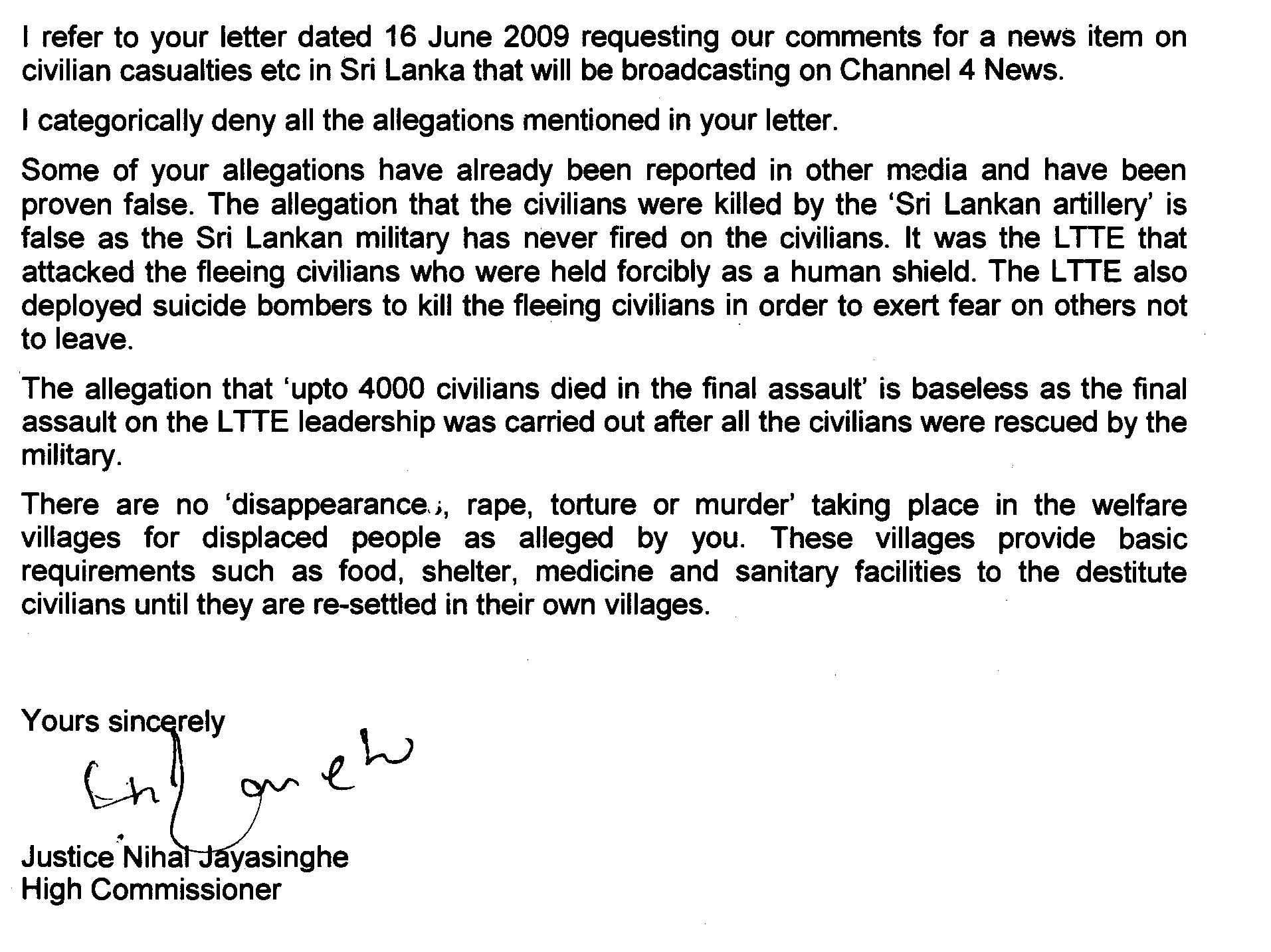
Fresh claim over tamilcasualties
By Jonathan Miller
A doctor working with injured and displaced Tamils in northern Sri Lanka tells Channel 4 News that there may be as many as 20,000 amputees among those who fled last month's routing of the Liberation Tigers of Tamil Eelam.
Eyewitnesses interviewed during a week-long undercover investigation for Channel 4 News, told of thousands of civilian deaths as government forces advanced on the Tigers' final stronghold.
The deaths, they said, were the result of government shelling.
The Sri Lankan president and senior government ministers have repeatedly denied causing a single civilian death in what the government had desginated a "no-fire zone."
International aid agencies believe as many as 100,000 civilians may have been trapped inside, under a fierce bombardment.
"I think every day a thousand people were killed," one of the very last to escape the tiny enclave told us. He was referring to the final two weeks of the conflict, during which the Sri Lankan government claimed not to have used heavy artillery.
"There were continuous shelling attacks," said the eyewitness. We have verified his identity as a man in a position of authority, but we are unable to reveal it.
Members of Sri Lanka's ethnic Sinhalese majority also expressed deep misgivings about the fate of the island's Tamil minority now that the Tamil Tigers have been so decisively defeated. Despite severe restrictions on access to camps for displaced civilians, evidence is emerging of maltreatment, despite a promise made by President Mahinda Rajapaksa in his "victory speech" to Sri Lanka's parliament.
Speaking in the Tamil language, the president promised equal rights for Tamils and took "personal responsibility" for protecting them.
"Our heroic forces," he said, "have sacrificed their lives to protect Tamil civilians." A senior Roman Catholic priest, who has worked with the displaced in the heavily militarised northern town of Vavuniya, said the triumphalism of Sinhalese was "very sad" to witness.
"There is no one to represent the aspirations of the Tamil community," he said. "They have a very uncertain future. It means they will live as a subjugated community, like under a foreign ruler."
One of the few senior members of the Tamil Tigers to have survived, Selvarasa Pathmanathan, its head of international relations, said yesterday that the rebels' struggle for a separate Tamil homeland would now continue from exile.
"The legitimate campaign of the Tamils to realise their right to self-determination has been brutally crushed through military aggression," said a statement, released from an unspecified location. Sri Lankans expressing concerns about the welfare and treatment of Tamil civilians -- or questioning the army's version of its final assault on the Tamil Tigers -- are branded unpatriotic, even traitorous.
Dr Wickramabahu Karunarathne, a left-wing politician and one of the few dissident voices in the Sinhalese community said: "The state media, every day, radio, papers, they classify us as traitors and they are rousing people against us."
Dr Karunaratne was the only interviewee prepared to talk openly on camera without having his face obscured and voice changed. One prominent Sinhalese journalist, Podala Jayantha, who had campaigned for greater media freedom, was abducted and severely beaten by unknown assailants, two weeks ago.
Amnesty International says that since 2006, 16 Sri Lankan journalists have been murdered, 26 assaulted, and many more detained. Foreign journalists have had their movements severely restricted and last month, our own accredited Asia Correspondent Nick Paton Walsh was deported.
Journalists and all independent observers were banned from the no-fire zone, during and after the fighting, so no independent assessments have been made of government claims not to have killed civilians. It has blamed any deaths on the rebels.
Journalists have also been unable to enter the hospital in Vavuniya, where thousands of wounded civilians are being treated. Channel 4 News successfully smuggled a small camera into Vavuniya and interviewed a Tamil doctor there.
"It is most sure that the numbers without limbs are over 20,000. Most of the injuries causing loss of limbs were from shelling," he said. The doctor alleged that conditions in the camps for displaced people around Vavuniya, are poor and that malnutrition and disease are rife.
"We were all gathered together recently by the government and we were told that if we told the figures of the sick and why people are dying to the foreign NGOs that we will be killed for doing this."
Response from the Sri Lanka government
http://www.channel4.com/news/media/2009/06/day17/srilanka_response_x.jpg
A doctor working with injured and displaced Tamils in northern Sri Lanka tells Channel 4 News that there may be as many as 20,000 amputees among those who fled last month's routing of the Liberation Tigers of Tamil Eelam.
Eyewitnesses interviewed during a week-long undercover investigation for Channel 4 News, told of thousands of civilian deaths as government forces advanced on the Tigers' final stronghold.
The deaths, they said, were the result of government shelling.
The Sri Lankan president and senior government ministers have repeatedly denied causing a single civilian death in what the government had desginated a "no-fire zone."
International aid agencies believe as many as 100,000 civilians may have been trapped inside, under a fierce bombardment.
"I think every day a thousand people were killed," one of the very last to escape the tiny enclave told us. He was referring to the final two weeks of the conflict, during which the Sri Lankan government claimed not to have used heavy artillery.
"There were continuous shelling attacks," said the eyewitness. We have verified his identity as a man in a position of authority, but we are unable to reveal it.
Members of Sri Lanka's ethnic Sinhalese majority also expressed deep misgivings about the fate of the island's Tamil minority now that the Tamil Tigers have been so decisively defeated. Despite severe restrictions on access to camps for displaced civilians, evidence is emerging of maltreatment, despite a promise made by President Mahinda Rajapaksa in his "victory speech" to Sri Lanka's parliament.
Speaking in the Tamil language, the president promised equal rights for Tamils and took "personal responsibility" for protecting them.
"Our heroic forces," he said, "have sacrificed their lives to protect Tamil civilians." A senior Roman Catholic priest, who has worked with the displaced in the heavily militarised northern town of Vavuniya, said the triumphalism of Sinhalese was "very sad" to witness.
"There is no one to represent the aspirations of the Tamil community," he said. "They have a very uncertain future. It means they will live as a subjugated community, like under a foreign ruler."
One of the few senior members of the Tamil Tigers to have survived, Selvarasa Pathmanathan, its head of international relations, said yesterday that the rebels' struggle for a separate Tamil homeland would now continue from exile.
"The legitimate campaign of the Tamils to realise their right to self-determination has been brutally crushed through military aggression," said a statement, released from an unspecified location. Sri Lankans expressing concerns about the welfare and treatment of Tamil civilians -- or questioning the army's version of its final assault on the Tamil Tigers -- are branded unpatriotic, even traitorous.
Dr Wickramabahu Karunarathne, a left-wing politician and one of the few dissident voices in the Sinhalese community said: "The state media, every day, radio, papers, they classify us as traitors and they are rousing people against us."
Dr Karunaratne was the only interviewee prepared to talk openly on camera without having his face obscured and voice changed. One prominent Sinhalese journalist, Podala Jayantha, who had campaigned for greater media freedom, was abducted and severely beaten by unknown assailants, two weeks ago.
Amnesty International says that since 2006, 16 Sri Lankan journalists have been murdered, 26 assaulted, and many more detained. Foreign journalists have had their movements severely restricted and last month, our own accredited Asia Correspondent Nick Paton Walsh was deported.
Journalists and all independent observers were banned from the no-fire zone, during and after the fighting, so no independent assessments have been made of government claims not to have killed civilians. It has blamed any deaths on the rebels.
Journalists have also been unable to enter the hospital in Vavuniya, where thousands of wounded civilians are being treated. Channel 4 News successfully smuggled a small camera into Vavuniya and interviewed a Tamil doctor there.
"It is most sure that the numbers without limbs are over 20,000. Most of the injuries causing loss of limbs were from shelling," he said. The doctor alleged that conditions in the camps for displaced people around Vavuniya, are poor and that malnutrition and disease are rife.
"We were all gathered together recently by the government and we were told that if we told the figures of the sick and why people are dying to the foreign NGOs that we will be killed for doing this."
Response from the Sri Lanka government
http://www.channel4.com/news/media/2009/06/day17/srilanka_response_x.jpg
Sri Lanka to get $ 2.5 B IMF loan
[ Daily Mirror ]
Sri Lanka is expected to receive a US $ 2.5 billion loan from the International Monitory Fund (IMF) this month, a top Central Bank official told Daily Mirror on condition of anonymity.
The loan is more than the US $ 1.9 B that Sri Lanka had sought from the IMF, the official added, although there was no official confirmation from the IMF yet.
A Reuters report, meanwhile, said Sri Lankan shares rose on Monday to a new nine-month high, led by foreign buying of blue chips on an expected IMF loan approval and continued local purchases of plantation and hotel shares.
The rupee closed flat as a state bank bought dollars. The Colombo All-Share Price Index rose 1.4 per cent or 31.50 points to 2286.12, its highest close since Sept 16.
“It was a very active market,” said Shivantha Meepage, a research analyst at Acuity Stockbrokers. “There is high hope of Sri Lanka getting the IMF loan soon. Foreigners bought blue chips, while retail investors bought plantation and hotel shares.”
Analysts say foreign funds have been slow to come to the market, which has been driven higher by retail buyers on positive sentiments since the war ended on May 18.
High oil prices, which go along with synthetic rubber prices, and high tea prices had pushed up plantation shares, analysts said. Oil eased to around $71 a barrel on Monday, retreating from a near eight-month high last week.
Sri Lanka’s average total tea price has jumped around 22 per cent to 342 rupees in May, from January on high global demand. The bourse has risen around 20 per cent since the government declared victory in the 25-year war and is up 52.1 per cent so far this year on post-war optimism.
Sri Lanka is expected to receive a US $ 2.5 billion loan from the International Monitory Fund (IMF) this month, a top Central Bank official told Daily Mirror on condition of anonymity.
The loan is more than the US $ 1.9 B that Sri Lanka had sought from the IMF, the official added, although there was no official confirmation from the IMF yet.
A Reuters report, meanwhile, said Sri Lankan shares rose on Monday to a new nine-month high, led by foreign buying of blue chips on an expected IMF loan approval and continued local purchases of plantation and hotel shares.
The rupee closed flat as a state bank bought dollars. The Colombo All-Share Price Index rose 1.4 per cent or 31.50 points to 2286.12, its highest close since Sept 16.
“It was a very active market,” said Shivantha Meepage, a research analyst at Acuity Stockbrokers. “There is high hope of Sri Lanka getting the IMF loan soon. Foreigners bought blue chips, while retail investors bought plantation and hotel shares.”
Analysts say foreign funds have been slow to come to the market, which has been driven higher by retail buyers on positive sentiments since the war ended on May 18.
High oil prices, which go along with synthetic rubber prices, and high tea prices had pushed up plantation shares, analysts said. Oil eased to around $71 a barrel on Monday, retreating from a near eight-month high last week.
Sri Lanka’s average total tea price has jumped around 22 per cent to 342 rupees in May, from January on high global demand. The bourse has risen around 20 per cent since the government declared victory in the 25-year war and is up 52.1 per cent so far this year on post-war optimism.
Search goes on for Aussies in Sri Lanka
AAP June 17, 2009, 6:30 pm
Australia is continuing the search for three NSW residents thought to be in refugee camps in northern Sri Lanka, where Tamils are being kept following the end of the civil war.
Human rights groups have labelled the camps a disgrace, urging Sri Lanka to free the 300,000 displaced people being held there.
Foreign Minister Stephen Smith put Sri Lanka on notice that it would be judged according to how it dealt with those in the camps.
"We think the Sri Lankan government and the Sri Lankan authorities will now be judged on two things - how they manage and deal with the vast number of people in the displaced camps," he told reporters.
"And ... how they move to a reform program that enables all of the Sri Lankan community to feel that they have a share in a democracy in Sri Lanka."
About 300,000 people are being held in the government-run camps following Colombo's defeat of the Tamil Tigers' long-running rebel campaign.
The government is keeping people in the camps until they determine whether they are members of the Tamil Tigers.
The three Australians - two women aged 26 and 29, and a 62-year-old man - believed to be in the camps are all from NSW.
Mr Smith said there was nothing to suggest they weren't safe.
"We currently have officials in the north of Sri Lanka to seek to locate the whereabouts of three Australian citizens who we believe are in one of the displaced persons camps," he said.
"We don't have any information that would cause us to believe that the three aren't safe.
"It's just we haven't been able to locate them, either through the UNHCR ... who are working in the displaced camps, nor have we been able to locate them through Sri Lankan authorities, but we are working very hard to do that."
The Tamil community in Australia is continuing to pressure Canberra to speak out about human rights in Sri Lanka.
It held a forum at Parliament House on Wednesday where community leaders spoke of the plight of the Tamils.
John Dowd, president of the Australian section of the International Commission of Jurists, told AAP the federal government needed to do much more to draw attention to the problems in Sri Lanka.
"They should be talking out volubly so that the rest of the world knows that Australia is concerned," he said.
"Its approach has been far too muted. The Australian government has conveniently not made as much of a fuss as it ought."
Paediatrician John Whitehall, an associate professor of public health at James Cook University, said it was a euphemism to call those in the camps displaced people.
"They are inmates of concentration camps and history has few precedents for incarcerating all the people after a civil war indefinitely and isolating them the way that they have," Dr Whitehall said
Australia is continuing the search for three NSW residents thought to be in refugee camps in northern Sri Lanka, where Tamils are being kept following the end of the civil war.
Human rights groups have labelled the camps a disgrace, urging Sri Lanka to free the 300,000 displaced people being held there.
Foreign Minister Stephen Smith put Sri Lanka on notice that it would be judged according to how it dealt with those in the camps.
"We think the Sri Lankan government and the Sri Lankan authorities will now be judged on two things - how they manage and deal with the vast number of people in the displaced camps," he told reporters.
"And ... how they move to a reform program that enables all of the Sri Lankan community to feel that they have a share in a democracy in Sri Lanka."
About 300,000 people are being held in the government-run camps following Colombo's defeat of the Tamil Tigers' long-running rebel campaign.
The government is keeping people in the camps until they determine whether they are members of the Tamil Tigers.
The three Australians - two women aged 26 and 29, and a 62-year-old man - believed to be in the camps are all from NSW.
Mr Smith said there was nothing to suggest they weren't safe.
"We currently have officials in the north of Sri Lanka to seek to locate the whereabouts of three Australian citizens who we believe are in one of the displaced persons camps," he said.
"We don't have any information that would cause us to believe that the three aren't safe.
"It's just we haven't been able to locate them, either through the UNHCR ... who are working in the displaced camps, nor have we been able to locate them through Sri Lankan authorities, but we are working very hard to do that."
The Tamil community in Australia is continuing to pressure Canberra to speak out about human rights in Sri Lanka.
It held a forum at Parliament House on Wednesday where community leaders spoke of the plight of the Tamils.
John Dowd, president of the Australian section of the International Commission of Jurists, told AAP the federal government needed to do much more to draw attention to the problems in Sri Lanka.
"They should be talking out volubly so that the rest of the world knows that Australia is concerned," he said.
"Its approach has been far too muted. The Australian government has conveniently not made as much of a fuss as it ought."
Paediatrician John Whitehall, an associate professor of public health at James Cook University, said it was a euphemism to call those in the camps displaced people.
"They are inmates of concentration camps and history has few precedents for incarcerating all the people after a civil war indefinitely and isolating them the way that they have," Dr Whitehall said
Subscribe to:
Posts (Atom)